
There are few voices more fitting to reflect on the power of language, identity, and transformation than journalist and broadcaster Mike McRoberts.
In the middle of Te Wiki o te Reo Māori, Mike sat down with us to talk about what it means to finally begin reclaiming that connection; to his language, to his whakapapa, and to himself.
For decades, Mike has been a familiar presence in New Zealand households as the 6 o’clock news presenter. But behind the poised delivery was a personal story of disconnection, rediscovery, and ultimately, reclamation. A journey that has led him to become a passionate advocate for te reo Māori and kaupapa Māori.
“Speaking My Language” 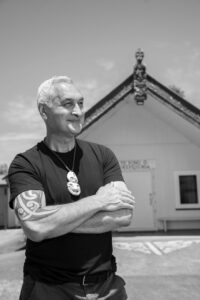
Mike has had a big year. He recently released his book Speaking My Language, a deeply personal account of his te reo Māori journey, which has sparked rich conversations across the motu. As he tours the country to share his story, it’s clear the book is more than a memoir; it’s a message of encouragement for anyone feeling hesitant about starting their own language journey.
“It’s been a busy week already,” he laughs. “But such a rewarding one. I’m grateful for the chance to have this kōrero.”
Mike’s journey toward learning te reo Māori started later in life, but its roots go back decades. Born in the 1960s, Mike grew up with little connection to his culture. His father had moved from Wairoa as part of the Māori Affairs Trade Training Scheme, an assimilation-driven programme that relocated young Māori into cities, often at the cost of cultural and linguistic identity.
“My dad was doing what he thought was best. He was strapped at school for speaking te reo Māori. Why would he want his kids to go through that?”
Disconnection and Whakama
Growing up, Mike often felt like an outsider, even to his own culture. Despite knowing he was Māori, he struggled with feeling ‘Māori enough’. Schooling in Christchurch offered French, but not te reo Māori. The opportunities weren’t there.
It’s a feeling many Māori share, and one that stops many from even beginning. But Mike compares it to going to the gym when you’re unfit: “How do you think you get fit? How do you think you learn? You start. That’s the only way forward.”
The Turning Point
That turning point came in his late 40s, when Māori TV offered te reo lessons through the Te Ataarangi method. He joined in and rediscovered something he hadn’t realised he was missing…joy, belonging, and connection.
“That environment was so full of manaaki. We made mistakes, we laughed a lot, but it was safe.”
Later, a chance encounter with a local handyman-turned kaiako (teacher) led to a year of private lessons with his whānau. When his kaiako returned to Taranaki, Mike and his wife Heidi kept going.
At the same time, Mike was approached by his employer to make a documentary about 50 years of the Māori language petition. He initially resisted: “I’m not worthy. I’ve only just started.”
But they wanted to share his story, as someone walking the path, not someone already at the summit. The result, Kia Ora, Good Evening, was a raw, emotional, and powerful documentary that deeply resonated across Aotearoa.
“I’ve reported on war zones and natural disasters, but that documentary is the proudest moment of my television career.”
Leaving the Newsroom to Walk the Kaupapa
After a 40-year career in broadcasting, Mike faced another turning point when Newshub was closed. While a new show was launched under different leadership, Mike decided not to continue. He had already begun thinking about his next move: kaupapa Māori.
“I wanted to do something that felt true to me. Something with purpose.”
That opportunity came swiftly. The National Business Review offered him a role as Te Ao Māori Editor, a new position designed to bring depth and understanding of Māori culture, values, and economic insight to their readers.
He accepted, despite knowing it wouldn’t be easy. “There are a handful of subscribers who hate everything I write,” he laughs. “But I tell them: the status quo you’re guarding doesn’t have status anymore.”
The Ripple Effect
What started as a personal language journey became a whānau-wide revival. Mike speaks of his father, once hesitant, now slowly dropping kupu Māori into their family chat, and of singing waiata at a whānau wedding together. He recalls taking 30 whānau members to their ancestral marae for the first time in years. “That connection is strong again. And it’s only getting stronger.”
He also highlights how corporate Aotearoa has begun embracing te ao Māori, with karakia, mihi, and Māori values now regular features of conferences and events.
“I see more people on this journey. And I say: wherever you are on the maunga, whatever pace you’re going, just stay on the mountain. That’s what matters.”
Final Reflections
Today, Mike is thriving in his new role, writing, speaking, and continuing to learn. His reo is still a work in progress, but he’s no longer afraid of mistakes. “We just need to normalise the fact that it’s hard, especially for us. It’s not like learning French. This is our language. That makes it beautiful. And heavy. And worth it.”
From nightly bulletins to kaupapa Māori advocacy, Mike McRoberts has transitioned from being a reporter of stories to being the story himself.
Ngā mihi nunui ki a koe, Mike,
Thank you so much for your time, your kōrero, and the wisdom you shared with the Careerforce whānau. Your insights, honesty, and the mana you bring to every conversation have truly inspired us.
We are grateful for your generosity in sharing your journey and for taking the time to connect with us.
Daisy Hemmingson-White