
Otago Corrections Facility and Careerforce partner to create pathways to success
Careerforce and the Department of Corrections are working in partnership at the Otago Corrections Facility (OCF) in Milton, where education is playing a powerful role in rehabilitation, connection, and future-focused change. People in custody and staff alike are gaining recognised qualifications, practical skills, and renewed confidence that are forging pathways that extend well beyond the prison gates.
Through Careerforce programmes delivered at the Otago Corrections Facility, people in prison are gaining industry-relevant qualifications, while Corrections staff are strengthening their practice through apprenticeships and professional development. The approach is supporting safer environments, stronger capability, and better long-term outcomes for individuals, whānau, and communities.
A partnership grounded in capability and opportunity
Sherie Lucke, Practice Manager for Education and Training across South Island Correction facilities, has played a key role in embedding Careerforce programmes within custodial settings.
She recognises that education has long been a catalyst for change. With nearly 18 years’ experience in Corrections, she has seen how training can transform the lives of people who may never have experienced success in education before.
“Education can be a powerful enabler,” Sherie says. “For many people in custody, completing a qualification builds confidence and creates a sense of achievement. It can change how they see themselves and their future.”
“Many of the men we work with have had difficult experiences with learning,” says Sherie. “When they complete a qualification, sometimes the first they’ve ever achieved, you see their confidence grow. It opens doors and changes how they see themselves.”
One of the first Careerforce programmes introduced at the Otago Corrections Facility was the New Zealand Certificate in Cleaning (Level 2). Following its success, the programme has been implemented across other South Island facilities. Corrections staff are trained by Careerforce as observers, enabling on-site assessment and ensuring learning is practical, consistent, and aligned with workplace standards.
“This partnership works because it’s built on shared values of respect, trust, and a genuine commitment to helping people reach their potential,” Sherie says.
Additional health and wellbeing unit standards are also being developed and piloted, supporting people in peer support and mentoring roles.
Frontline learning with real impact
For Louise, a Corrections Officer, completing a Whānau, Community and Social Services apprenticeship through Careerforce has strengthened both her practice and her sense of purpose.
“The apprenticeship has helped me understand the men more deeply and given me better tools to support their rehabilitation,” Louise says. “It also made me reflect on myself, and when I work better on myself, that flows through to how I care for others.”
Louise describes the culture at the workspace as one of whānau, where staff support one another and carry that same sense of belonging into their work with people in prison. Success, she says, is often found in small but meaningful moments and changes such as a change in behaviour, a quiet apology, or someone leaving custody with hope, supports in place and a plan for the future.
Practical skills with recognised outcomes
Sally Scott, a Kitchen and Laundry Instructor and Corrections Officer at the Otago Corrections Facility, brings learning to life through her hands-on work supporting people to complete Careerforce cleaning qualifications at levels 2 and 3. With a background in hospitality and adult education, Sally brings a structured, supportive approach to work-based learning.
As a trained observer, she provides guidance, assessment, and feedback aligned with Careerforce standards. Her focus is on ensuring learners understand expectations, build confidence, and complete qualifications that are recognised by employers.
“These people are motivated and capable,” Sally says. “When they’re given the opportunity to learn and succeed, they rise to it.”
“These qualifications provide practical skills and support employment opportunities after release,” Sally says. “They give people a sense of achievement and a credential they can take with them.”
Sally is also completing a Whānau, Community and Social Services apprenticeship through Careerforce, further strengthening her values-based approach and understanding of trauma-informed and culturally responsive practice.
Supporting rehabilitation and reintegration
The partnership between Careerforce and Corrections supports a coordinated approach to rehabilitation by linking learning to real work, recognised qualifications, and future employment pathways. By building staff capability and supporting people in custody to succeed in education, the partnership contributes to safer environments and improved reintegration outcomes.
“This work is about creating opportunities and supporting positive change,” Sherie says. “When people gain skills and confidence, the benefits extend far beyond the individual, to their whānau and the wider community.”
Careerforce and the Department of Corrections remain committed to working together to expand access to work-based learning and support positive, long-term outcomes across custodial settings.
Creating real skills, real confidence, and real futures.
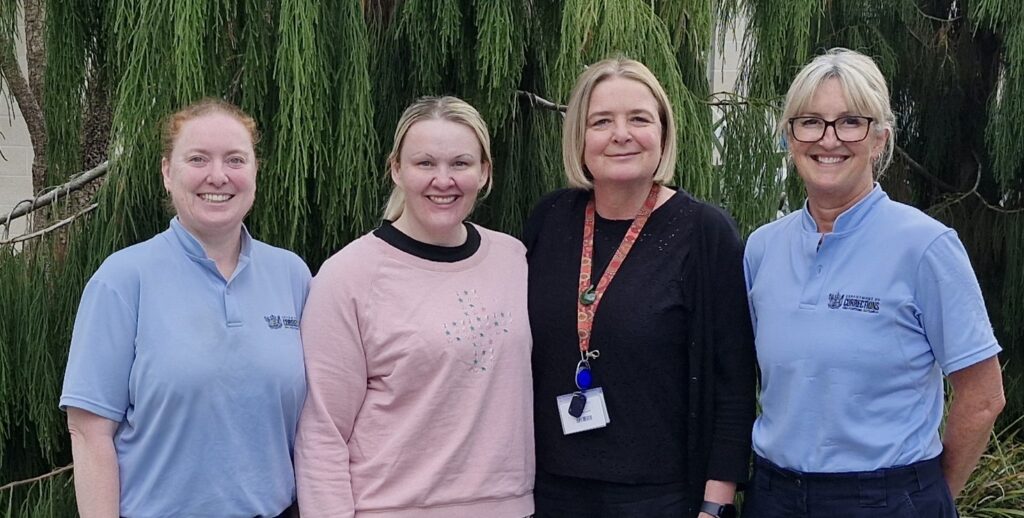
From left to right; Sally Scott (Corrections), Jess Hannah (Careerforce), Sherie Lucke (Corrections) and Louise Dale (Corrections)
For all media enquiries, please contact Paul Williams, Senior Manager Marketing, Communications & Insights on 027 600 7395, or at [email protected].
Careerforce supports employers across New Zealand’s health and wellbeing sectors to run workplace training programmes, allowing staff to achieve nationally recognised qualifications on the job. For more information, please see: www.careerforce.org.nz
Daisy Hemmingson-White